
Why Your AC Cools Less Every Year
How runtime, not the calendar, wears a Phoenix system down
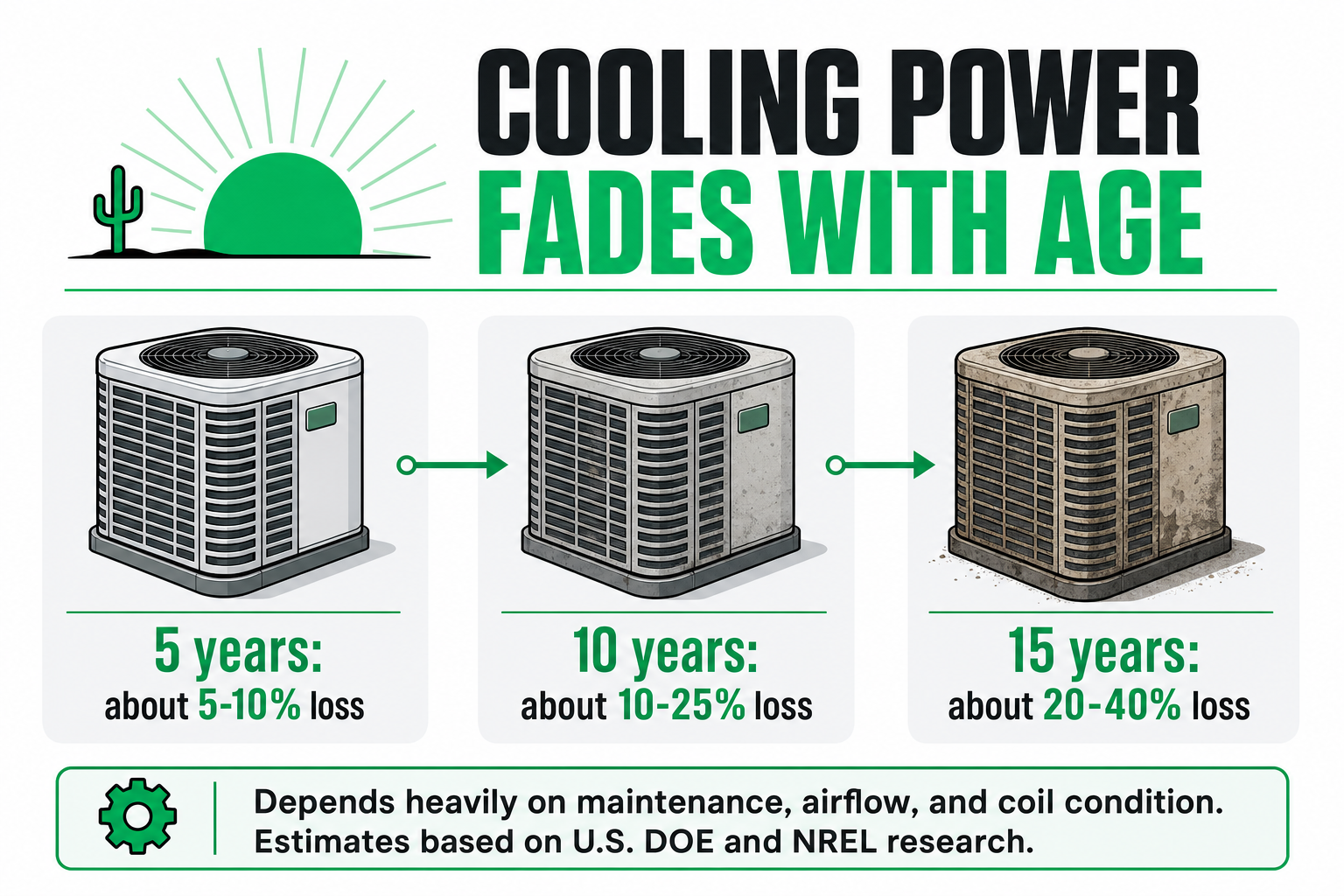
An AC can keep cooling while quietly losing capacity. Estimates based on U.S. Department of Energy and NREL research put typical loss at about 5-10% by year 5, 10-25% by year 10, and 20-40% by year 15, though it depends a lot on maintenance, airflow, and coil condition. In Phoenix, systems age by runtime, not birthday: they log 1,500 to 2,500+ cooling hours a year versus 300 to 800 in mild climates, so a 10-year-old Phoenix AC can carry the wear of a 15- to 20-year-old system elsewhere. Cleaning the coils and blower wheel can often restore 5-15% of lost performance, but it cannot bring back cooling lost to worn-out parts.
Quick Comparison
| Factor | Clean and Maintain It | Replace the System |
|---|---|---|
| System age in Phoenix runtime | Under about 10 years | 12-15+ years of hard runtime |
| Cooling capacity lost so far | About 5-25% (years 5-10) | About 20-40% (year 15+) |
| What cleaning can recover | 5-15% back from clean coils and airflow | Little; loss is in worn parts |
| Repair pattern | First real repair | Repeat repairs each cooling season |
| Compressor and motors | Sound; strain eases with service | Worn from years of runtime |
Detailed Breakdown
Clean and Maintain It
- Costs far less than replacing
- Cleaning can restore 5-15% of lost cooling
- Eases strain on the compressor and motors
- Improves airflow right away
- Gets good years from a system that is still sound
- Cannot recover cooling lost to worn parts
- Results depend on coil and airflow condition
- Efficiency still trails a modern system
- Does not undo years of Phoenix runtime
Systems under about 10 years old that still cool on most days, where the drop traces to dirty coils, a fouled blower wheel, or weak airflow rather than a tired compressor.
Replace the System
- Restores full cooling capacity
- Lower runtime cost from modern efficiency
- Fresh compressor and motors built for Phoenix hours
- Comes with a new parts warranty
- May qualify for SRP or APS rebates
- Higher upfront cost
- Install takes planning and a day or two
- A bigger decision than a service visit
Systems past 12 to 15 years of Phoenix runtime, or ones losing 20-40% of their cooling with repeat repairs each season, where cleaning cannot reach the worn compressor, motors, and electrical parts driving the decline.
Phoenix-Specific Considerations
In Phoenix, an AC does not just get older. It gets more worn out. Our cooling season is long and brutally hot, so systems here run 1,500 to 2,500+ hours a year while systems in mild climates run 300 to 800. That is two to three times the cooling hours. AC ages by runtime, not by the date on the label, which is why a 10-year-old Phoenix system can carry the wear of a 15- to 20-year-old system in a cooler area.
Heat pumps run in winter too
If your system is a heat pump, it also heats the home in cooler months, so it adds more total runtime and wear than a cooling-only AC. More seasons of use means the same aging math moves faster.
What cleaning can and cannot do
Cleaning the coils and blower wheel on the manufacturer's schedule helps the system breathe and cool better, and can often restore 5 to 15% of lost performance. A dirty system may gain even more. What cleaning cannot do is bring back cooling lost to worn-out parts, and how much you recover depends a lot on maintenance history, airflow, and coil condition.
Our Recommendation
Good installation, regular maintenance, and clean equipment are how you get the most comfort and the longest life out of a Phoenix system. ENERGY STAR, APS, and SRP recommend taking a serious look at replacement once an air conditioner passes 10 years old (Source: energystar.gov), and in our climate those years carry more runtime than most. If your cooling has slipped and you are not sure whether a good cleaning or a full replacement is the smarter move, call us at 602-560-8989. We will measure what your system is actually doing and give you honest, no-pressure options.
Frequently Asked Questions
Yes. As an AC ages it loses cooling capacity, so it runs longer to reach the same temperature. Worn compressors, tired motors, and dirty coils all make the system work harder for less cooling. In Phoenix, where units already run 1,500 to 2,500+ hours a year, that extra runtime shows up on your bill. The system still cools, it just costs more to do it.
Partly. Cleaning the coils and blower wheel on the manufacturer's schedule improves airflow and can often restore 5 to 15% of lost cooling, and a dirty system may gain even more. It also eases strain on the compressor and motors. What cleaning cannot do is bring back performance lost to worn-out parts.
Because Phoenix systems age by runtime, not by birthday. A unit here can run two to three times more cooling hours than one in a mild climate. That means a 10-year-old Phoenix AC may carry the wear of a 15- to 20-year-old system somewhere cooler. The calendar says ten years, but the compressor, motors, and electrical parts have logged far more.
They take on more total runtime. A heat pump cools in summer and also heats the home in cooler months, so it runs across more of the year than a cooling-only AC. More seasons of use means more wear over time. That does not make a heat pump a worse choice. It does mean maintenance and cleaning matter even more to reach a full life.
There is no fixed date, but ENERGY STAR, APS, and SRP recommend looking at replacement once an AC passes 10 years old (Source: energystar.gov). In Phoenix those years carry heavier runtime than most climates, so watch for rising bills, weaker cooling on hot days, and repeat repairs. Good maintenance stretches a system's life; heavy runtime and worn parts shorten it.
Still Not Sure? We Can Help.
Get a free, no-pressure assessment. We'll give you honest advice, even if it means recommending the less expensive option.