
What Determines New AC Cost in Phoenix
Why the install decides the real cost, not the sticker
A new AC quote in Phoenix comes down to four things: the tonnage a Manual J load calculation says your home actually needs, the equipment tier you pick, the condition of your existing ductwork and electrical, and how complete the installation is. The installer you choose affects what the system costs you over its whole life more than the number on the bid does. When bids differ, check the scope first: the lowest price is usually not a comparable product. Any company that quotes a firm price sight unseen is guessing. Local Roots quotes flat-rate after we look at your home in person, and that estimate is free.
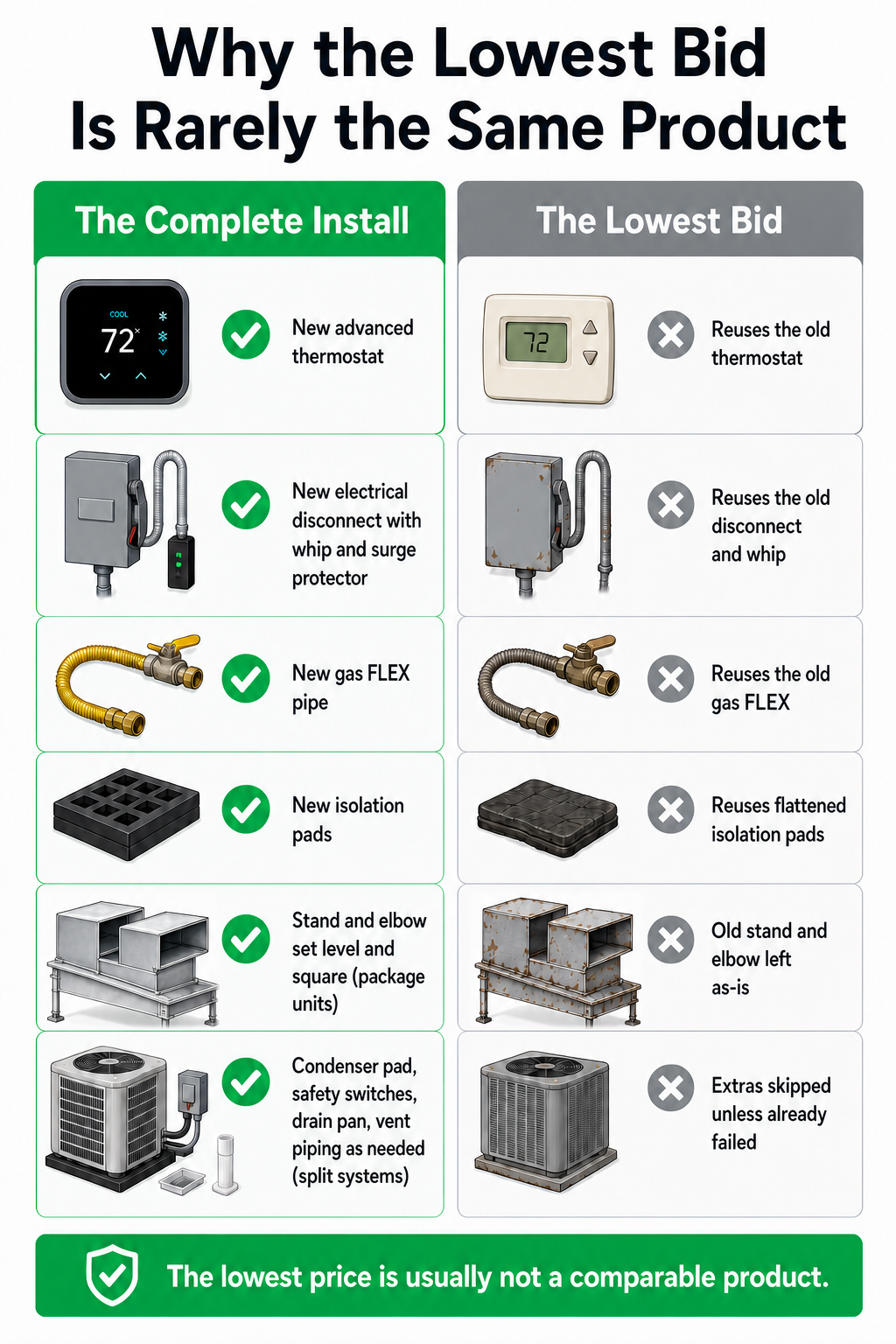
Quick Comparison
| Factor | The Lowest Bid | The Complete Install |
|---|---|---|
| Thermostat | Existing thermostat reused | New advanced thermostat included |
| Stand and elbow (package units) | Old stand and elbow reused as-is | New, set level and square with clean duct seal lines |
| Electrical disconnect and whip | Existing disconnect reused | New disconnect with whip and surge protector |
| Gas flex pipe | Old gas line parts reused | New gas flex, plus a new gas valve on package units |
| Isolation pads | Worn pads reused | New pads to cut vibration and noise |
| Sizing | Same tonnage as the old unit or a square-foot guess | Manual J load calc for your home |
| Split-system extras | Left in place unless they have already failed | Condenser pad, safety switches, drain pan, plenum, vent piping replaced as needed |
Detailed Breakdown
The Lowest Bid
- Lowest number up front
- Fast and simple to compare across bids
- Reasonable when every bid covers the same complete scope
- Budgets are real, and a lower bill is a lower bill
- The lowest bid often hits its number by reusing worn components
- Skipped sizing can leave you with a system that never keeps up in July
- Reused parts can mean reduced performance and higher repair risk
- Shorter system life usually costs more than you saved on day one
- You rarely find out what was left out until something fails
Homeowners comparing bids that all cover the same complete scope, where sizing is done and the same components are being replaced, so the only real difference left is the price.
The Complete Install
- New components mean fewer early repairs
- Correct sizing means the system keeps up on the hottest days
- A cleaner, safer install that holds up longer
- Lower lifetime cost, even when the sticker is higher
- You know exactly what you are paying for
- Not always the lowest number on day one
- Takes a real in-home look to quote honestly
- Asks you to weigh the crew and the scope, not just the bid
Homeowners who plan to stay in the home and want a system that lasts, where the goal is the lowest cost over the life of the unit, not just the lowest price to start.
Phoenix-Specific Considerations
Phoenix punishes shortcuts. A worn part that would coast for years in a mild climate gets pushed hard here, where AC runs eight to ten months a year against a 107 degree design day. That is why the reused-versus-new question below matters more in the Valley than almost anywhere else.
What a complete install actually includes
On a package unit, common in Phoenix on flat and low-slope roofs, a complete install replaces the parts a bare-minimum swap leaves in place: a new thermostat, a new stand and elbow set level and square, a new electrical disconnect with whip and surge protector, a new gas valve and flex pipe, and new isolation pads. On a split system we still replace the thermostat, the disconnect and whip, the gas flex, and the isolation pads, and where the job calls for it: the condenser pad, safety switches, secondary drain pan, attic plenum and unit support, vent piping, scuttle kit, and return air grilles. A cheaper bid can reuse or skip every one of those and still call it a new AC. That is the heart of it: the lowest price is usually not a comparable product. The bare minimum can mean reduced performance, higher repair risk, and shorter system life.
Sizing is the biggest lever on the bill
Two questions separate a real quote from a guess: did you run a Manual J load calculation, and what are you replacing versus reusing? A Manual J accounts for Phoenix attic temperatures, west-facing glass, insulation, and duct leakage instead of matching the tonnage of the old unit. Bigger is not better here. An oversized system short-cycles, wastes energy, and leaves humidity unmanaged, so the wrong size costs you every summer it runs. Utility rebates from SRP and APS can lower the equipment cost, and we handle that paperwork for you. Industry data backs this up: AHRI notes that properly sized and installed equipment can reduce energy use by as much as 35 percent, and that the loss from poor sizing and installation can outweigh the savings from stepping up to high-efficiency equipment.
Our Recommendation
Price-shopping is fair, and a tight budget is real. The trap is comparing bids that are not the same job. When one quote sizes the system with a Manual J and replaces the worn components and another quietly reuses them, the lower number often moves the cost to your future repair bills instead of removing it. We quote flat-rate after a free in-home look, we include what we would sell our own grandmother, and our installs carry a lifetime workmanship warranty. Financing is available for qualified buyers. Call 602-560-8989 to schedule your free in-home estimate.
Frequently Asked Questions
Because an honest price depends on things nobody can see over the phone: the load your home puts on the system, the shape of your ductwork and electrical, roof access, and what needs replacing versus what can stay. A firm number quoted sight unseen is a guess that gets corrected later. We look first, then quote flat-rate, so the number we give you is the number you pay.
Start with a Manual J load calculation so the system is sized for your home, not the old unit. On a package unit, a complete install also means a new thermostat, a new stand and elbow, a new electrical disconnect with whip and surge protector, a new gas valve and flex pipe, and new isolation pads. If a bid reuses those worn parts, ask why, because that is where a low number usually comes from.
Only if it covers the same work. A bid often hits a low number by skipping the load calculation and reusing worn components, which can mean reduced performance, more repairs, and a shorter system life in Phoenix heat. Once you add those future costs back in, the cheap bid frequently ends up costing more. Compare scope first, then compare price. Same job, lowest price wins. Different jobs are not the same deal.
No. Our in-home installation estimate is free. We visit, measure, run the Manual J load calculation, check the ductwork and electrical, and finalize a flat-rate quote you can hold us to. There is no charge and no obligation to move forward.
We offer promotional financing through our financing partner for qualified buyers, including shorter promotional terms and longer fixed-payment options. Which offers you qualify for depends on the application. We walk through the current options and monthly payments at the in-home estimate so you can weigh them against paying up front.
Still Not Sure? We Can Help.
Get a free, no-pressure assessment. We'll give you honest advice, even if it means recommending the less expensive option.