
Your Home's Water Shutoff & PRV, Explained
Find the valve that stops a flood before you need it
On most Phoenix homes, your water meter sits in a box near the street, but that is the city's valve, not the one you want in an emergency. Your own main shutoff is at the front wall of the house, usually near an outdoor faucet and often right next to a bell-shaped pressure regulator. Find it today and make sure it turns. The worst time to go looking is with water already running across the floor.
Quick Comparison
| Factor | Shut It Off at the House | Shut It Off at the Meter |
|---|---|---|
| Where it is | Front wall, near a hose bib | Curb box out by the street |
| Tool you need | Just your hand | A meter key |
| How you turn it | Ball valve a quarter turn; gate valve, several turns | Turn the curb stop with the key |
| What it shuts off | Your whole house | Everything at the source |
| When to use it | First choice in any leak | Only if the house valve fails |
| Watch out for | Seized older gate valves | City's valve; can seize too |
Detailed Breakdown
Shut It Off at the House
- Easier and safer, no special tools
- Shuts off water to your whole house
- The valve you should find and test today
- Right at the front wall, near a hose bib
- Only works if the valve isn't seized
- Older gate valves can stick or snap
- No good if you don't know where it is
Almost every water emergency: a burst supply line, a leaking water heater, an overflowing toilet, when the house valve turns freely. This is the one to reach for first.
Shut It Off at the Meter
- Works when the house valve is stuck or missing
- Stops water at the source, before the house
- Needs a meter key, not a screwdriver
- The curb stop is the city's valve, not yours
- Some utilities discourage customers from using it
- Buried valves seize and boxes fill with debris
A last resort, when your house-side valve won't budge or you can't find it and water is actively flooding. Turn the curb stop gently; forcing an old one can break it.
Phoenix-Specific Considerations
Phoenix homes are built on a concrete slab, with no basement and no crawlspace, so the pipes that bring water in run through the front wall instead of down into a cellar. Plumbers call this whole cluster the service entry. Here is each part, what it does, and what trouble looks like.
The parts where water enters your home
- Water meter (the curb box). The city's box near the street measures what you use. The valve inside it, the curb stop, belongs to the utility. A meter that keeps spinning with everything shut off points to a leak on your side.
- Water service line. The private pipe running from the meter to your house. Past the meter, it is yours to maintain. Wet spots in the yard or a jump in your bill can mean it is leaking underground.
- Main shutoff valve. Your emergency off switch, at the front wall near a hose bib. A quarter-turn ball valve is the modern type; an older round-handle gate valve is the one that tends to seize.
- Pressure regulator (PRV). The bell-shaped valve just inside the main shutoff. Phoenix streets can run past the pressure house plumbing is built for, so the city has you keep one here, usually set around 45 to 60 psi. When it fails, pressure swings high or drops off.
- Hose bibs. Your outdoor faucets. Code calls for an anti-siphon vacuum breaker on each one so hose water cannot get pulled back into your drinking supply. Our hard water chews through their washers first.
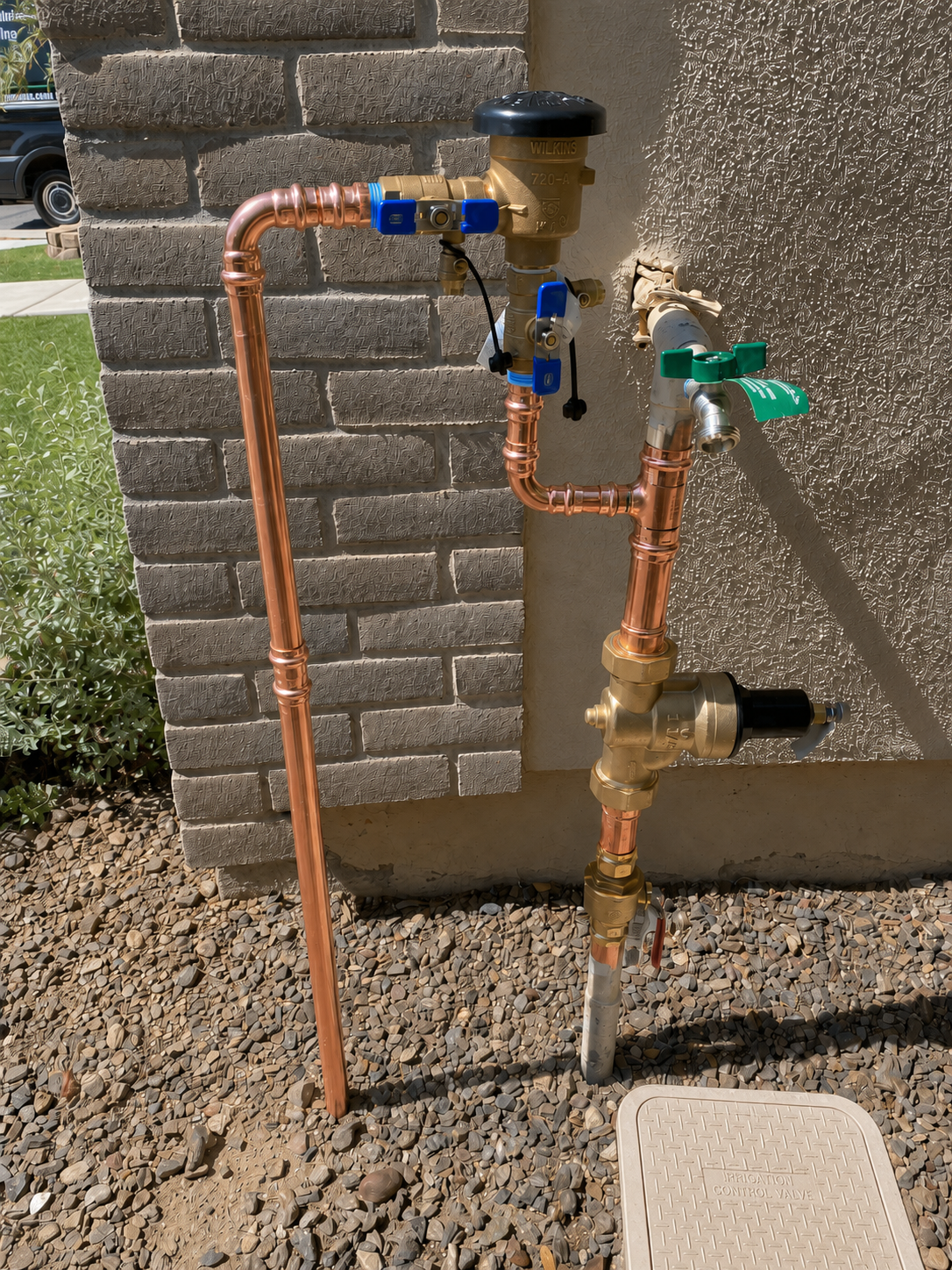
- Irrigation take-off and backflow preventer. Most Phoenix yards tee off the service entry to feed the sprinkler and drip system, through a backflow preventer that keeps irrigation water out of your drinking lines. If you see a brass unit with a bell-shaped cap standing above the pipe, that is it doing its job.
- Water heater shutoff. The valve on the cold-water line on top of the tank. Closing it stops water to the heater without shutting down the rest of the house.
What Phoenix does to this hardware
Our water runs hard, 12 to 20 grains per gallon depending on your provider. That scale builds up inside valves and eats hose-bib washers faster than it would in a softer-water city. It is also why an old gate valve on the main can freeze in place; the modern fix is a full-port ball valve that opens and closes with a quarter turn.
Heat is the other factor. Years of desert sun age the rubber diaphragm inside a PRV, which is why a worn regulator sits behind so many high and low water pressure complaints in the Valley.
One more note for older homes: if yours dates to the galvanized-pipe era, the service line and the valves at the wall may be near the end of their run, and rusty or restricted water is the tell. That is a conversation about repiping, not a single valve swap.
Our Recommendation
Do one thing this week: walk to the front wall, find your main shutoff, and turn it just enough to be sure it moves. If it is stuck, corroded, or your home still has its original gate valve, leave it alone and call us. Forcing a seized main valve is how a small problem becomes a flooded house at ten at night. If you suspect the leak is already hidden underground, we can trace it before we dig. We are family-owned, we quote flat-rate up front, and the estimate is free. Call Local Roots at 602-560-8989.
Frequently Asked Questions
On a Phoenix home, check the front wall, usually near an outdoor faucet, for a valve on the pipe coming up out of the ground. That is your main shutoff, the one to use in an emergency. The meter box by the street holds the city's valve, which needs a meter key and is meant as a backup, not your first move.
Phoenix water mains can push pressure past the level house plumbing is built to handle, so the city has you keep a pressure regulator on your side of the meter. It holds your home in a safe range, usually 45 to 60 psi. Without it, high pressure hammers fixtures, wears out washers, and can shorten the life of your water heater.
A failing PRV usually shows up as pressure that swings, strong one day and weak the next, or a slow drop across the whole house. You might also hear banging pipes or notice faucets that sputter. Because the rubber inside ages in our heat, regulators do wear out; if the symptoms match, start with our low water pressure guide, then have it checked.
Often, yes. A hose bib is one of the more DIY-friendly plumbing parts. The catch is code: your outdoor faucet needs an anti-siphon vacuum breaker so hose water cannot siphon back into your drinking water, and the connection has to seal cleanly. If the pipe threads into the wall, the shutoff is stuck, or you hit corrosion, that is the point to call. Our faucet repair team handles hose bibs too.
Water service entry is the plumber's name for the cluster of parts where water enters your home: the service line from the meter, the main shutoff, the pressure regulator, and the nearby hose bib. On a Phoenix slab home, all of it sits at or near the front wall rather than in a basement. Knowing the name helps when you are describing a problem to us over the phone.
Still Not Sure? We Can Help.
Get a free, no-pressure assessment. We'll give you honest advice, even if it means recommending the less expensive option.